As fall settles over Northern New Jersey, homeowners in Cedar Grove, Montclair, and North Caldwell enter a critical window to prepare their properties for winter. The weight of snow and ice will soon test every branch and trunk, and hidden weaknesses often don’t show themselves until storms strike.
That’s why early fall is the best time for a professional tree risk assessment. Trees are still fully accessible, and the seasonal transition makes structural problems easier to spot before dormancy. Addressing these risks now helps prevent costly damage and ensures your trees head into winter in their strongest condition.
Key Takeaways
- Fall assessments prevent costlier winter emergencies by finding structural risks before heavy snow loading.
- TRAQ-certified evaluations exceed basic inspections through systematic hazard identification and structural defect analysis.
- City permit requirements vary significantly across Bergen, Essex, Passaic, and Morris counties, with fines ranging from hundreds to thousands of dollars for non-compliance.
- Professional assessments identify hidden risks that DIY evaluations often miss, including co-dominant stem failures, root zone problems, and disease progression that threatens the stability of mature trees.
- Early hazard identification saves thousands through preventive pruning and treatment, rather than emergency removal and property damage repair.
Why Fall Is the Best Time for Tree Risk Assessments
Fall in Northern New Jersey creates a narrow but critical window for tree risk assessments. As trees shift toward dormancy, hidden structural issues become easier to spot – and with mild weather, it’s still safe to complete a thorough inspection.
The importance of timing is clear when you look at what happened last year. In November 2024, nearly 20 inches of snow fell at High Point Monument, with heavy accumulation across Sussex, Morris, and Passaic counties. Trees that looked perfectly healthy in summer couldn’t handle the sudden weight of ice and snow, and many came down, causing costly damage. A simple fall assessment could have flagged those risks before winter hit.
“Fall gives us the perfect opportunity to evaluate tree structure before winter stress tests every weakness. We can identify problems while solutions are still cost-effective. This is better than dealing with emergency removals after damage occurs.” – Casey Walentowicz, Licensed Tree Expert and Owner of Aspen Tree Service
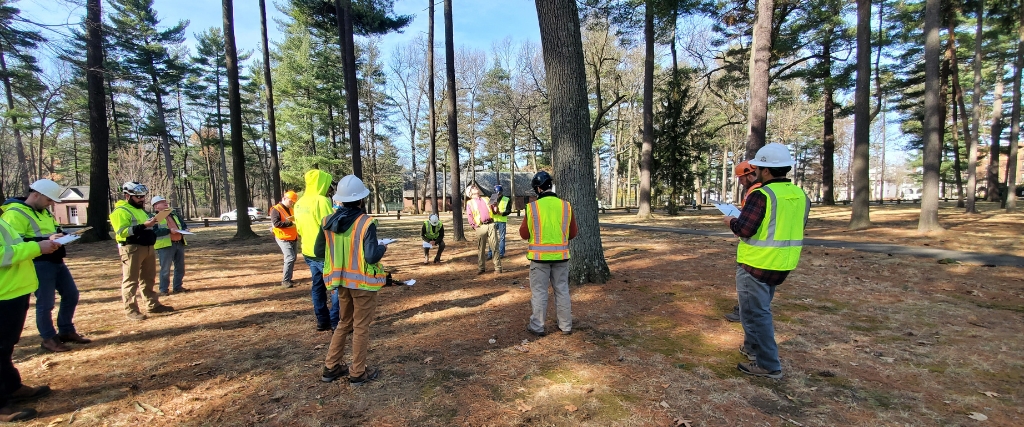
TRAQ certification provides specialized training in systematic tree risk assessment methodology.
What TRAQ-Certified Professionals Catch That Homeowners Miss
It’s easy to spot a tree that’s obviously failing – a large dead branch, visible lean, or one with a bare canopy this past summer. But many of the most dangerous hazards aren’t obvious without a trained eye. That’s where TRAQ-certified arborists provide value. They’re trained to read subtle “warning signs” and use systematic methods to predict failures before they happen.
Here’s what a professional fall risk assessment often uncovers:
Structural Weaknesses Hidden in Plain Sight
Mature maples and oaks common across Northern NJ often develop co-dominant stems – two trunks growing from the same point. While they look sturdy, the bark between them forms a seam that splits easily under snow and ice. Homeowners rarely notice this until failure occurs. Arborists know how to spot these stress points and recommend cabling or pruning before winter loading.
Storm-Damaged Wood That Still Looks “Healthy”
Summer thunderstorms often leave behind weakened limbs that don’t fully break. These partially fractured branches, sometimes called “hangers,” may not look dangerous until snow or ice adds weight. Arborists can identify these stress fractures and remove or stabilize them before they become emergencies.
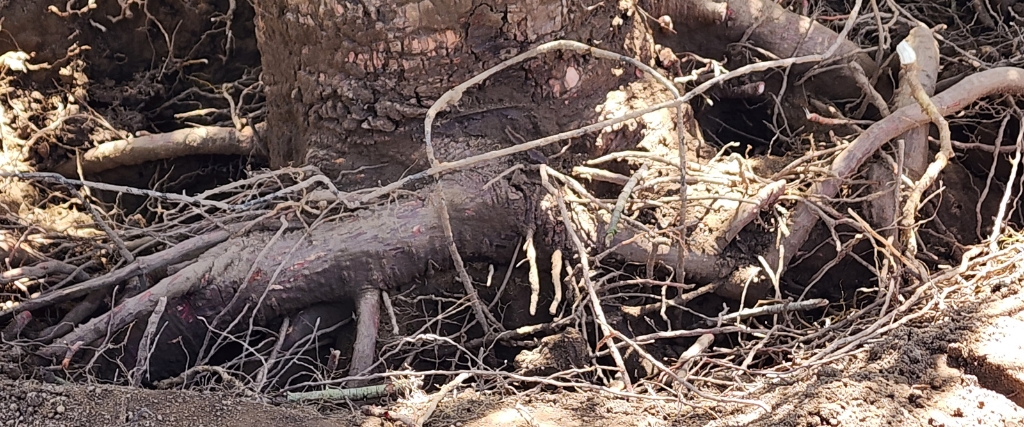
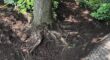
Root zone damage from construction often requires professional evaluation to assess tree stability.
Root Zone Compromise
Roots provide more than water – they anchor the entire tree. Soil compaction from construction, hidden root rot, or changes in drainage can weaken stability years before canopy symptoms appear. A tree that looks fine above ground may actually be unstable below. Certified arborists assess the root flare, soil condition, and site history to determine hidden risks.
Disease and Decay Below the Surface
Mushrooms at the base of a tree often indicate decay, but only a trained arborist can determine how far it has progressed. Internal cavities or insect activity, like emerald ash borer, may leave a tree outwardly green but structurally unsound. Professional evaluations include species-specific knowledge to distinguish between cosmetic issues and serious hazards.
Target and Site Risks
Beyond tree health, professionals also evaluate what’s at risk if the tree fails. Is the tree leaning toward your house? Over a driveway? Near power lines? A TRAQ assessment weighs not only the likelihood of failure but also the potential consequences – something a homeowner walkaround can’t fully capture.
The bottom line: a tree doesn’t need to look sick to be dangerous. Professional risk assessments catch problems before they escalate, giving homeowners time to address hazards on their schedule rather than paying for costly emergency removals after a storm.
How Professional Tree Risk Assessments Work
A TRAQ-certified assessment isn’t just a quick walkaround. It’s a structured process that evaluates trees from the roots up, using both visual inspection and diagnostic tools when needed. The goal is to determine the likelihood of failure or potential consequences and recommended action.
Here’s how the process typically unfolds:
-
Site Evaluation: Arborists start by reviewing the property as a whole. They identify “targets” – homes, driveways, power lines, walkways — that would be affected if a tree or limb fails. This sets the stage for prioritizing which trees pose the greatest risk.
-
Visual Tree Assessment (VTA): This internationally recognized protocol analyzes tree “body language.” Arborists look at root flare exposure, trunk taper, bark seams, branch angles, and crown symmetry to identify weaknesses.
-
Advanced Diagnostics When Needed: If a tree exhibits signs of internal decay or root compromise, tools such as resistographs (to measure internal wood strength) or ground-penetrating radar (to assess roots) may be employed. These technologies provide data beyond what the eye can see.
-
Risk Rating and Recommendations: Each tree is assigned a risk rating (low, moderate, high, or extreme) based on both the likelihood of failure and the potential consequences associated with it. Homeowners then receive a written report with photos, documentation, and recommended actions, whether pruning, cabling, monitoring, or removal.
This process ensures that decisions are based on evidence, not guesswork, and gives homeowners a clear plan for managing tree risks before winter.
Local Permit Rules You Can’t Ignore
Navigating city tree regulations across Bergen, Essex, Passaic, and Morris counties requires understanding a complex web of local ordinances. Each has specific requirements and penalties. The New Jersey Department of Environmental Protection’s MS4 stormwater permit requirements have prompted all cities to adopt or strengthen tree removal and replacement ordinances.
- Montclair: $15 permits for trees 8+ inches diameter at breast height, strict Licensed Tree Expert contractor requirements, tree restoration plans required with replacement requirements, or $250 contributions to Municipal Tree Replanting Fund
- Bergenfield: Shade Tree Committee oversight requiring permits for tree work on public property or rights-of-way, with emphasis on construction protection and root zone preservation during building projects
- Wayne Township: Department of Parks and Recreation permit system with municipal court summons and fines up to $1,000 for contractors performing work without approved permits
- Caldwell Borough: Comprehensive Tree Removal and Protection Ordinance requiring mitigation plans and mandating 15-day response periods for applications
Consequences of Non-Compliance
Cutting corners on local tree ordinances can get expensive fast. Fines often range from hundreds to thousands of dollars per tree, and most towns treat each removal as a separate violation. In some cases, stop-work orders can delay construction projects, while replanting requirements may force you to replace each tree with several new ones.
However, the risks go beyond money. Unauthorized removals can also create liability if neighboring properties are affected — for example, by destabilized soil, drainage issues, or increased storm damage risk.
Working with a Licensed Tree Expert ensures your tree risk assessment comes with proper documentation and permit guidance. This way, you avoid costly penalties and keep your property fully compliant.
Frequently Asked Questions
When should I schedule a tree risk assessment in New Jersey?
Fall offers the ideal timing for a comprehensive tree risk assessment in Northern New Jersey. Trees are transitioning toward dormancy, making structural issues more apparent while mild weather conditions still allow thorough evaluation. This timing provides maximum opportunity for preventive action before winter weather arrives. However, you can schedule a tree risk assessment any time. We work all year.
What’s the difference between TRAQ certification and basic tree inspection?
TRAQ certification represents advanced training in systematic tree risk assessment methodology, including hazard identification, failure probability analysis, and risk rating systems. Basic inspections might identify obvious problems, but TRAQ-certified professionals use internationally recognized protocols to evaluate structural integrity, assess target risks, and provide comprehensive hazard analysis that casual observation cannot match.
Do I need permits for tree risk assessments in Northern NJ?
Tree risk assessments themselves typically don’t require permits, but any resulting work often does. Most municipalities across Bergen, Essex, Passaic, and Morris counties require permits for tree removal or significant pruning. Professional assessments provide documentation necessary for permit applications and help ensure compliance with local regulations.
What’s the difference between a Licensed Tree Expert and a Licensed Tree Care Operator in NJ?
Licensed Tree Experts (LTEs) can provide comprehensive tree services, including assessment, diagnosis, treatment, consulting, and specialized services such as cabling and bracing. Licensed Tree Care Operators (LTCOs) are limited to basic services, such as pruning, removal, and stump grinding. For professional tree risk assessments, consultation, and treatment recommendations, you need a Licensed Tree Expert.
What happens if my trees fail a risk assessment?
Trees that present unacceptable risks require mitigation action, which might include pruning to reduce weight load, installing support systems like cables or braces, or removal if risks cannot be adequately managed. Professional arborists provide prioritized recommendations based on risk levels, helping you address the most serious hazards first while budgeting for necessary work.
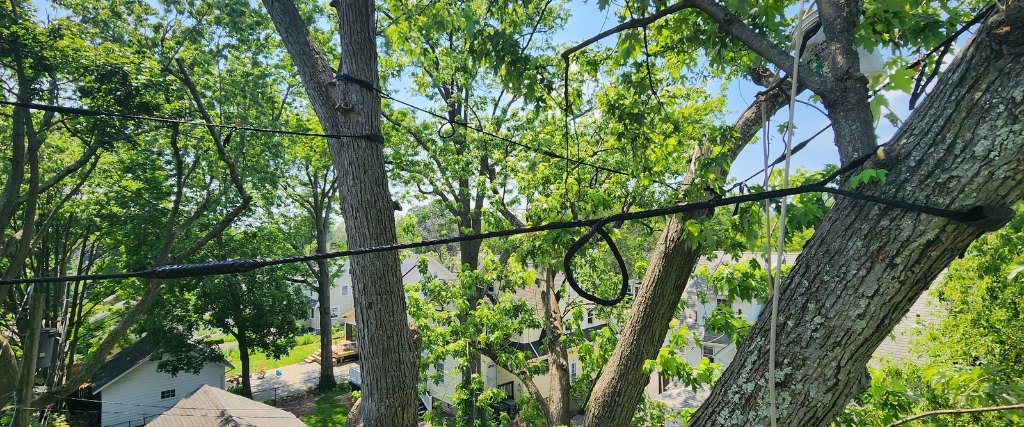
Installing cables in a tree will reduce the risk of failure during a winter storm.
Protect Your Northern NJ Property with a Professional Tree Risk Assessment
Don’t wait until winter weather tests every weakness in your trees. Professional tree risk assessment in the fall provides the critical evaluation necessary to identify hazards while solutions remain cost-effective. Aspen Tree Service brings TRAQ-certified expertise and Licensed Tree Expert credentials to complete hazard evaluation. We serve Bergen, Essex, Passaic, and Morris counties.
Our systematic assessment process identifies structural defects, evaluates failure probability, and provides detailed documentation for city permit requirements. Our team will give you an honest assessment and can provide services to keep your tree standing.
Schedule your professional tree risk assessment today by calling 201-939-8733 or request your consultation online.