On oak trees across Montclair, Verona, and countless other Northern NJ communities, there are tan, fuzzy, quarter-sized patches that cling to branches and trunks. Each of those egg masses contains anywhere from 500 to over 1,000 caterpillars waiting to hatch in late April. Once they emerge, they can strip a mature oak bare in weeks. This is why spongy moth protection is vitally important for homeowners across New Jersey.
If your property has oaks, the clock is ticking and the threat is building. In 2025, the NJ Department of Agriculture enhanced its aerial spongy moth suppression program to over 13,000 acres, up 1,400 from the year before. But statewide programs can’t protect individual properties — what happens on your trees depends on the steps you take now.
Key Takeaways
- In Northern NJ, spongy moth egg masses hatch from late April to early May. Homeowners with oak trees should look over their property and schedule professional treatment before caterpillars start appearing.
- Healthy deciduous trees can survive two to three consecutive years of heavy defoliation, but those already stressed by drought, compacted soil, or other pests may not recover from even a single season.
- The caterpillars themselves are not the real danger; the secondary pests and diseases, such as two-lined chestnut borer and Armillaria root rot, attack weak oaks after defoliation.
- Homeowners can eliminate egg masses and install burlap bands, but mature oaks over 30 feet in height may need professional equipment and accurately timed biological treatments.
- Btk (Bacillus thuringiensis var. kurstaki) treatments only work during a short window in early to mid-May, when newly hatched caterpillars are actively feeding.
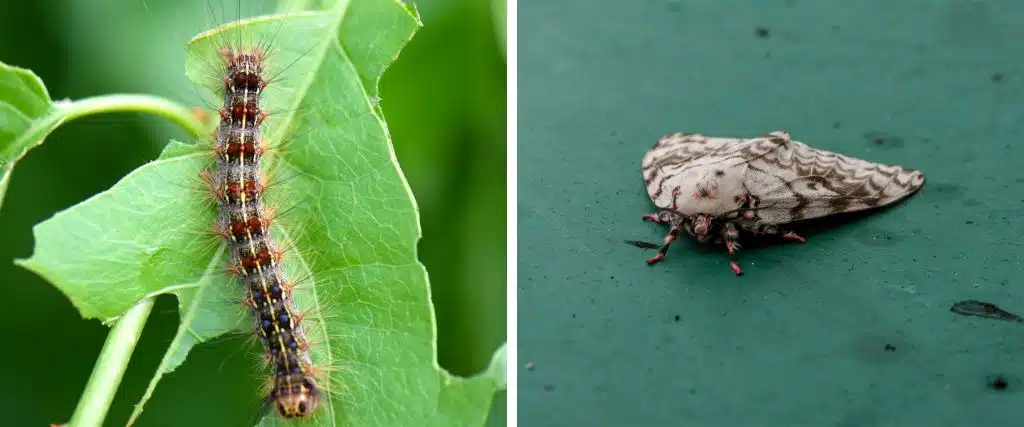
Left photo: Spongy moth caterpillar feeding on leaves of a tree; Right photo: Adult female spongy moths are white with dark markings and do not fly. After mating in midsummer, each female lays a single egg mass containing up to 1,000 eggs.
What Is a Spongy Moth?
Spongy moth (Lymantria dispar) is an invasive insect from Europe that feeds on over 300 species of trees, with oaks being its most preferred host. You may also recognize it by its former name, “gypsy moth,” which was officially changed in 2022 by the Entomological Society of America.
This pest is especially problematic in areas like Verona and Montclair, where mature oak canopies are common — from the red oaks in Upper Montclair’s neighborhoods to the hardwood stands around Verona Park. These landscapes provide an ideal food source during peak feeding season.
Spongy moths spend the winter as egg masses on tree trunks and nearby surfaces. In late April to early May, caterpillars hatch and begin feeding for about six weeks before pupating. Adults emerge in midsummer, mate, lay new egg masses, and restart the cycle.
Why Are Oak Trees Most Vulnerable to Spongy Moth?
Three factors make oaks the primary targets of spongy moth:
- Oak Trees Are Widespread Across New Jersey: Oak and hickory forests are among the most common in the state, and the northern red oak is New Jersey’s official state tree. This abundance creates a large, consistent food source for spongy moth caterpillars in Northern NJ neighborhoods.
- Oak Leaf Emergence Aligns with Caterpillar Feeding: Spongy moth eggs hatch in sync with the emergence of oak leaves in spring, giving caterpillars immediate access to fresh foliage as soon as they become active.
- Oak Trees Experience the Most Severe Damage: Among hardwood species, oaks suffer the highest mortality rates because they are the preferred host and endure the most defoliation. Properties with multiple mature oaks essentially provide a continuous food source, increasing risk in areas like Upper Montclair and near Verona Park.
How Do You Prevent Spongy Moth Damage to Oak Trees in Spring?
The most effective protection combines physical removal, biological treatment, and trapping, though each method works best at a specific point in the pest’s lifecycle.
Remove Egg Masses (Now Through April)
Scrape egg masses into a container of soapy water and let soak for at least 48 hours before discarding. Do not knock them to the ground, as the eggs can still hatch there. For masses that are hard to scrape cleanly, saturating with horticultural oil is a solid alternative. The drawbacks come from reach: this works for what you can reach from the ground, but large oaks will have egg masses well above that height.
Apply Btk at the Right Time (Early to Mid-May)
Bacillus thuringiensis var. kurstaki (Btk) is a naturally occurring bacterium that targets caterpillars while remaining safe for people, pets, and beneficial insects. It is the most widely recommended biological treatment for spongy moth. Btk has to be applied when caterpillars are young and actively feeding, which in Northern NJ falls from early to mid-May. Treatments applied before the hatch or after caterpillars mature are notably less effective.
Homeowners can treat small trees (under 30 feet) with Btk using a compressed air sprayer, but the 60- to 80-foot oaks common on Montclair and Verona properties require professional equipment for adequate canopy coverage.
A professional tree inspection can identify spongy moth egg masses, assess overall tree health, and determine whether treatment is needed before caterpillars hatch.
Use Burlap Bands to Reduce Caterpillar Numbers (Mid-May)
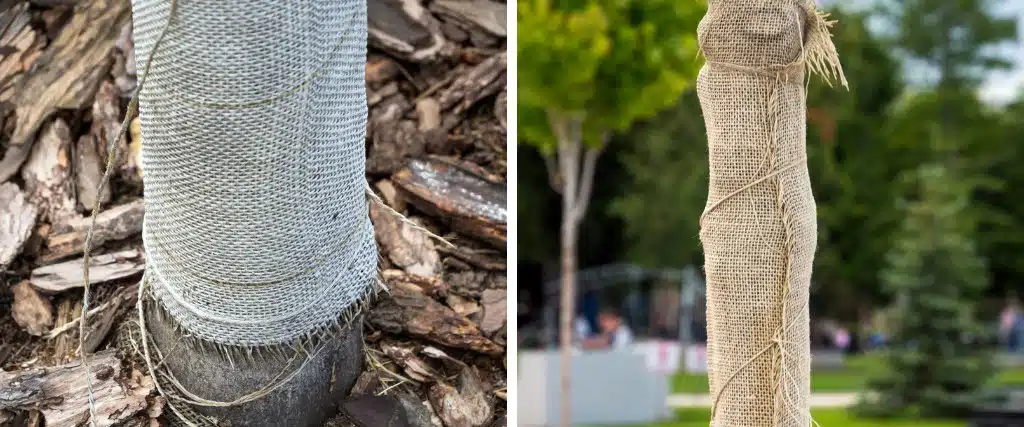
Wrap an 18-inch-wide strip of burlap around the tree’s trunk at chest height. Then, fold the top half down to create a sheltered pocket. Caterpillars crawling down during daylight tuck under the fold. Every day, check the bands and drop caterpillars into soapy water. This lessens the numbers on individual trees but is not a standalone solution during instances of heavy infestation.
IMPORTANT: Rutgers University’s Cooperative Extension no longer recommends sticky barrier bands due to their risk to birds and beneficial insects.
How Do You Know If You Have Spongy Moth on Your Trees?
Look on tree trunks for tan, quarter-sized patches (egg masses) and hairy caterpillars with unique blue and red raised spots along their backs.
Egg Mass Identification (Fall Through Spring)
Spongy moth egg masses are seen on trees from late summer through the following spring, which establishes a clear removal window. Each mass is:
- Tan or buff-colored, about the size of a quarter, with a texture that is fuzzy or felt-like
- Found on a tree’s trunk and branches, but can also be found on stacks of firewood, outdoor furniture, play equipment, fences, and vehicles
- Packed with 500 to 1,000 eggs
Caterpillar Identification (Late April Through June)
After they’ve hatched, spongy moth caterpillars grow to 2.5 inches in length and are covered in coarse hairs. The key identification feature is their unique pattern of dots: five pairs of raised blue spots followed by six pairs of raised red spots along the back. This differentiates them from lookalikes like the eastern tent caterpillar.
Starting at dusk, caterpillars climb trees to feed through the night. At dawn, they descend to shelter in crevices in the tree’s bark or debris at the base of it. This daily migration is what makes specific trapping methods effective. It is important to note that caterpillar hairs can cause skin irritation, so wear gloves while handling them.
When Is Professional Spongy Moth Treatment Necessary?
Professional treatment becomes necessary when your oaks are too tall for DIY methods, you are finding high counts of egg masses across numerous trees, or your trees are already stressed by drought, compacted soil, or prior pest damage.
Why Btk Treatments Require Professional Timing and Equipment
Btk only works during a narrow window when caterpillars are small and actively feeding. Apply it too early (before the hatch) or too late (after caterpillars mature past their early instars), and the treatment is significantly less effective. For the 60- to 80-foot oaks typical of Montclair and Verona properties, professional spray equipment is the only way to reach the full canopy.
An arborist using an integrated pest management approach studies caterpillar populations, overall tree health, and property-specific factors to construct a tailored, targeted plan for treatment. This is not a one-size-fits-all spray; it is a customized plan based on what your trees actually need.
What Happens If You Don’t Treat Spongy Moth Early?
The biggest risk from spongy moth is not the defoliation itself; it is the chain reaction of secondary issues that follows. A healthy, deciduous tree can survive two to three years consecutively with heavy defoliation. “Healthy” is the operative word, however, and many oaks in suburban Northern NJ are already compromised.
Why Some Oaks Don’t Recover from Defoliation
Trees dealing with drought stress (Northern NJ experienced extreme drought in both 2024 and 2025), compacted soil, or pre-existing pressure from pests may not survive even one season of heavy defoliation. A defoliated tree uses most of its stored energy reserves to push out a second flush of leaves in midsummer, leaving it with little left for growth the following year.
Secondary Threats That Kill Weakened Oaks
Once an oak is weakened by defoliation, two secondary threats move in:
- Two-Lined Chestnut Borer: A bark beetle that targets stressed oaks, boring into the cambium layer. It can kill branches or entire trees within a single growing season.
- Armillaria Root Rot: A soil-borne fungal disease that attacks roots of weakened trees. Once established, it is usually fatal.
This is why meticulous tree preservation matters much more than simply spraying for caterpillars. An arborist analyzes structural integrity, soil health, root zone condition, and existing stress factors.
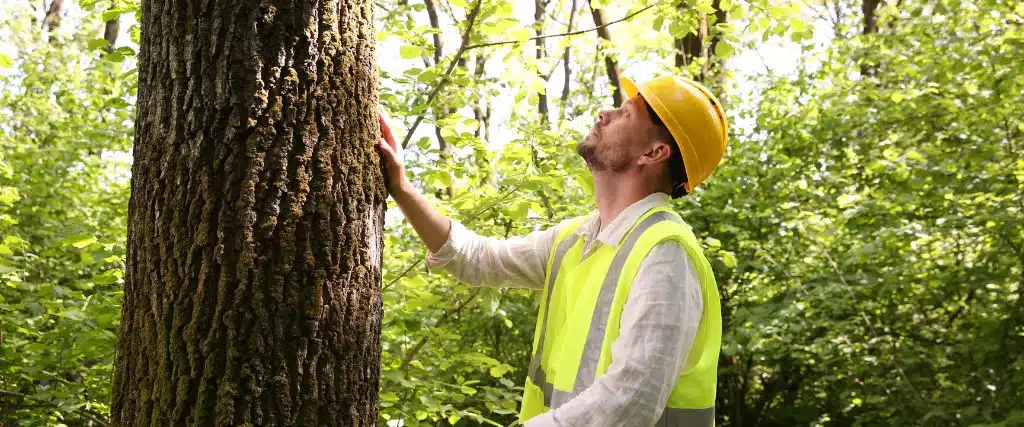
A professional tree inspection can identify spongy moth egg masses, assess overall tree health, and determine whether treatment is needed before caterpillars hatch.
Frequently Asked Questions About Spongy Moth
Can a tree survive spongy moth defoliation?
Healthy deciduous trees can usually survive two to three consecutive seasons of heavy defoliation. Trees already stressed by drought, compacted soil, or other issues may worsen or die altogether after just one season.
When do spongy moth eggs hatch in New Jersey?
In Northern NJ, spongy moth egg masses generally hatch in late April through early May, coinciding with oak leaf-out. Caterpillars feed for around six weeks through mid-June.
What is the best treatment for spongy moth caterpillars?
Btk (Bacillus thuringiensis var. kurstaki) is the most commonly recommended biological treatment. For mature trees, professional intervention is necessary for sufficient canopy coverage.
How do I tell the difference between spongy moth and eastern tent caterpillar?
Spongy moth caterpillars have five pairs of blue spots and six pairs of red spots along their backs and do not build tents. Eastern tent caterpillars create visible silk tents in branch crotches and have a pale stripe down their backs.
Does New Jersey have a spongy moth control program?
Yes. The NJ Department of Agriculture provides aerial Btk treatments over qualifying forested areas (over 500 egg masses per acre, at a minimum of 40 acres). This covers municipal properties, not individual lots. For your property, contact a licensed tree expert.
Protect Your Oaks from Spongy Moth by Calling Aspen Arborist & Tree Services Today
Spongy moth egg masses are covering trees right now, and the late April hatch is about to begin. Look over your trees, remove whatever you can reach, and schedule professional treatment for the oaks that need it most.
Adequate protection goes beyond simply killing caterpillars. You have to assess your trees’ overall health and prevent the secondary damage effects that turn defoliation into total tree loss.
For nearly four decades, Aspen Tree Services has been protecting Northern NJ’s trees. Call 201-939-8733 or request an estimate online to schedule a spongy moth protection assessment before the beginning of the May treatment window.