In South Bergen County, mature maples and oaks tend to grow two competing trunks from a single fork. That V-shaped union, especially when it contains included bark, can be a structurally weak point that may separate under heavy wind or snow loads. When the surrounding wood is still sound, tree cabling and bracing can reduce movement and failure risk in trees, holding the union together for years to come.
Whether a support system can help depends on what’s causing the weakness and the condition of the rest of the tree. An arborist can assess the union, trunk, canopy, and surrounding targets to determine whether cabling or bracing can provide meaningful support or whether another solution is safer.
Key Takeaways
- Whether a splitting or leaning tree can be safely preserved depends on the severity of the defect, the tree’s overall condition, and the risk it poses if it fails.
- Cabling and bracing can provide extra support for some structurally weak trees, but it doesn’t fix the underlying defect and requires ongoing inspection.
- Support systems should be installed by a qualified arborist following ANSI A300 standards, not by a general handyman.
- A structural assessment always comes first to determine whether cabling or bracing is appropriate and what type of support the tree needs.
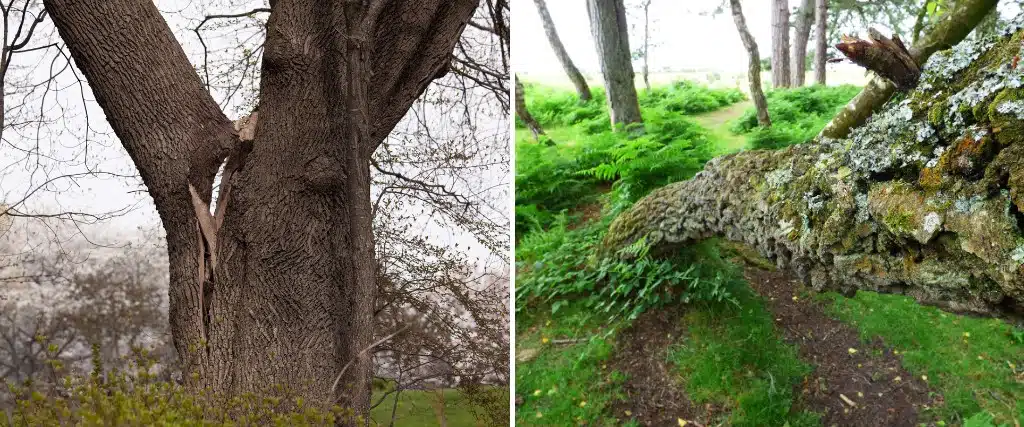
Splits and significant leans can indicate structural concerns, but whether a tree can be preserved depends on the cause, severity, and overall condition of the tree.
Can a Splitting or Leaning Tree Be Saved?
Yes, sometimes. Whether your tree can be saved depends on the location of the weakness and what a credentialed arborist finds when they look at the entire tree, not just the crack or lean you noticed. The same defect can mean two different outcomes: a sound tree with a fixable structural issue or a tree that has already lost too much for it to be saved.
How Does an Arborist Determine If a Tree Can Be Saved?
A Certified Arborist examines the defect and tree as a whole before deciding whether to support, prune, or remove it. The evaluation involves:
- The union or defect itself
- The soundness of the wood around it
- The cause of any lean
- The target zone below the tree, such as a house, driveway, or cars
- The tree’s overall health
An arborist consultation gives you a written recommendation that clarifies whether the tree can be saved and, if necessary, sets up the periodic inspections a support system needs. Before winter comes, when ice and snow test every weak union, a tree health assessment or a fall tree risk assessment can identify structural concerns so they can be addressed before winter weather puts additional stress on the tree.
Which Trees Can Be Supported with Cabling or Bracing?
Cabling and bracing is worth it for trees such as:
- A healthy, valued mature tree with a co-dominant or V-shaped union (a tight fork with a dark seam of trapped bark, called included bark)
- An over-extended limb, or a minor, early-stage split, where the union is unsound but the wood around it stays solid
- Species that commonly grow co-dominant stems, such as maples, oaks, and many conifers, plus any limb whose diameter passes about half the trunk’s, where its attachment to the trunk starts to weaken
If you’ve got a tree showing warning signs of a hazardous tree, treat a sudden lean or worsening crack as a reason to call an arborist as soon as possible.
How Can Cabling and Bracing Support a Weak or Splitting Tree?
Cabling and bracing are support hardware installed by an arborist to reinforce a tree with a weak or splitting union. They restrain how much the union flexes under load, so it isn’t as likely to fail in wind, ice, or snow.
Tree cabling and bracing do different jobs, but usually work together:
- Cabling: A flexible, high-strength cable is installed high in the canopy to limit how far two leaders can spread apart and help distribute wind loads across the tree.
- Bracing: Rigid, threaded steel rods are installed through a weak or cracked union to reinforce the connection and help prevent further separation.
On a split union, an arborist generally combines the two, setting rods through the union and running cables above. Under ANSI A300, a support system supplements the tree’s natural structure rather than replacing it, which is why it needs to be inspected by an arborist every so often. For a heavy, over-extended limb, structural pruning to reduce the weight is sometimes used alongside a cable or in place of one.
Who Should Install Tree Cabling and Bracing?
A Certified Arborist should install tree cabling and bracing, since cable placement, hardware, and loads are governed by ANSI A300 standards and depend on assessing each individual tree.
Why a Credentialed Arborist Is Needed
The cable alone has to sit about two-thirds of the way up toward the branch tips. Getting hardware or placement wrong can worsen a defect, which is why most general tree guys and handymen don’t do this work well. Structural support is work that requires high-level skill, and Aspen’s lead arborist holds the named, difference-making credentials:
- ISA Certified Arborist
- New Jersey Licensed Tree Expert (#689)
- Tree Risk Assessment Qualified (TRAQ) Arborist
These credentials matter more than a clean install. Determining whether your tree should be supported or taken down is a judgment only a Certified Arborist is trained to make.
When Is Tree Removal a Better Option?
Not every tree has enough structural integrity left for pruning or cabling and bracing to significantly reduce the risk. So, removal is the safer and more honest call for trees like:
- A dead tree, or one with heavily decayed or hollow wood, since nothing sound remains for cables or rods to hold
- A lean caused by root failure, because cabling the canopy cannot fix a problem down at the roots
Frequently Asked Questions About Cabling and Bracing
Can a tree be cabled after it’s already started to split?
Sometimes. A support system can be installed reactively after a union begins to crack or separate, but an actively splitting union requires prompt professional assessment because the tree may already have an unacceptable risk of failure.
Does every tree need both cabling and bracing?
Not always both. A cable on its own can be enough to limit movement on a weak but still-intact union, while a cracked or splitting union usually needs rigid rods to hold the parts together. When bracing rods are used, an arborist may also install a cable higher in the crown to limit movement and reduce loading on the repaired union.
How long does tree cabling and bracing last?
A well-installed system can hold for many years. It is not install-and-forget, though: as the tree grows and hardware ages, the system may require adjustment, maintenance, or replacement.
What is a co-dominant stem?
It is a tree with two near-equal main stems rising from one junction, forming a narrow V rather than a strong, U-shaped fork. Bark often gets trapped in the tight seam (included bark), which keeps the two stems from bonding and leaves a weak point that can split under wind, ice, or the tree’s own growing weight.
Does cabling and bracing hurt the tree?
Properly selected and installed support systems are designed to minimize unnecessary injury while reducing structural movement. Because installation creates wounds and hardware remains in the tree, the benefits and risks should be considered for the individual tree.
Is cabling and bracing worth it?
For a healthy, valued tree with a defect at the union, structural support lets you keep a mature tree that would take decades to replace, and itcan reduce the likelihood of structural failure and help manage risk to nearby targets. For a dead or root-failed tree, removal is the honest call, and an assessment determines what’s best for your property.
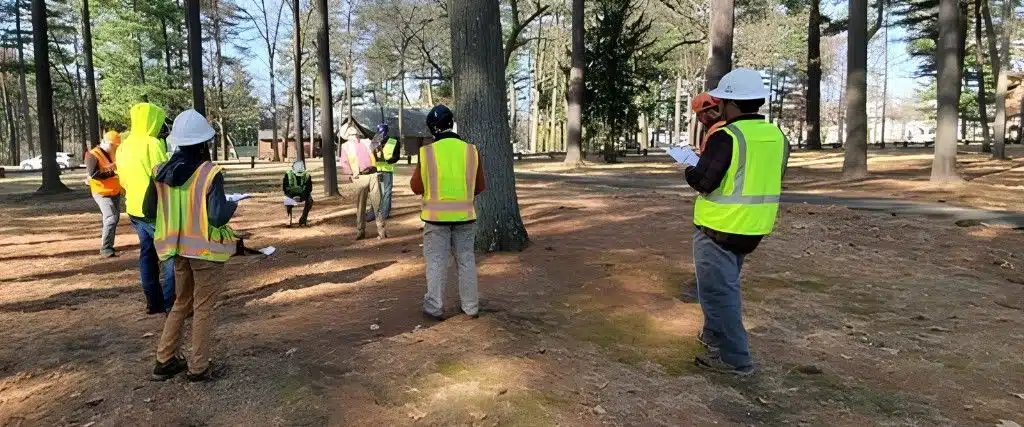
Every job starts with a credentialed arborist evaluating the whole tree, not just the visible defect.
Call Aspen Tree’s Arborists to Assess Your Tree
If your tree endangers a house, driveway, or car, have it looked at while there are still options. You can schedule an assessment with an arborist from our team at Aspen Tree or, if you know you need a specific piece of work done, you can call us at 201-419-5194 or request a free quote online. Either way, we’re here and ready to help.